


Many people dream of spending more than just a few weeks in Japan.
Perhaps you are retired and would like to spend several months exploring the country. Maybe you want to experience everyday life in Japan rather than rushing from one tourist destination to another. Or perhaps you simply have the financial freedom to take an extended break abroad.
But what if you do not intend to work in Japan?
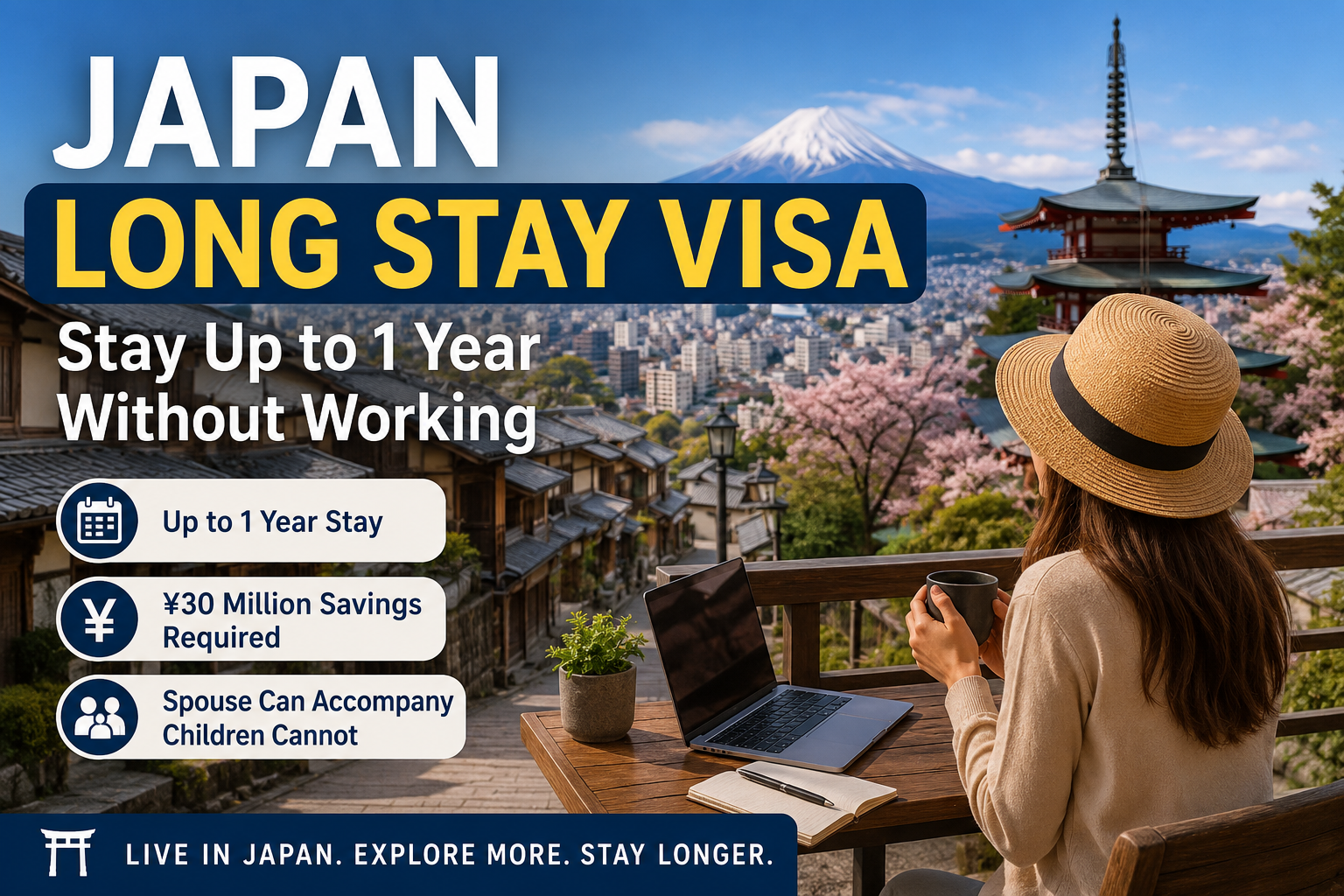
There is a little-known immigration option that may allow certain foreign nationals to stay in Japan for up to one year for sightseeing and recreation.
It is called Designated Activities (Long Stay for sightseeing and recreation).
Unlike the Digital Nomad status, this option is not designed for people working remotely from Japan. It is intended for people who have sufficient financial resources to support themselves while enjoying an extended stay in the country.
How Long Can You Stay?
The initial period of stay is six months.
However, if you meet the requirements, you may apply for an extension of your period of stay at a Regional Immigration Services Bureau in Japan before the initial six-month period expires.
If the extension is approved, your total stay can be extended to a maximum of one year.
This makes the program very different from ordinary short-term visits, which generally allow visa-exempt visitors to stay for much shorter periods.
Who Can Use This Option?
The main applicant must:
- Be 18 years of age or older;
- Be a national or citizen of a visa-exemption country or region;
- Have sufficient savings to meet the financial requirement; and
- Have appropriate private medical travel insurance covering the stay in Japan.
This means the program is not available to everyone. Nationality and financial eligibility are important.
For the official eligibility requirements, see the Ministry of Foreign Affairs guidance on Long Stay for sightseeing and recreation.
The ¥30 Million Savings Requirement
The most significant requirement is financial.
The applicant must have access to savings equivalent to more than ¥30 million.
Under the official rules, the savings may be owned by the applicant and the applicant’s spouse.
When applying without a Certificate of Eligibility, applicants may be required to provide documentation such as bank records showing not only the current balance but also deposits and withdrawals during the previous six months.
This is therefore not simply a matter of showing a large balance on one particular day. Applicants should be prepared to provide documentation demonstrating their financial situation.
Can Your Spouse Come With You?
Yes.
An accompanying spouse may also qualify under the program. The spouse is generally expected to have the same place of residence and travel together with the principal applicant while in Japan.
The spouse does not necessarily have to enter Japan at exactly the same time as the principal applicant, but the spouse cannot enter Japan before the principal applicant under this category.
There is also an important financial rule.
If both spouses intend to use this scheme but stay separately rather than as an accompanying couple, they must have combined savings equivalent to more than ¥60 million.
What About Children?
This is one of the important limitations of the program.
Dependent children cannot accompany their parents under this particular Long Stay category.
This is a significant difference from some other Japanese residence statuses, including the Digital Nomad category, under which a spouse or child may potentially accompany the principal applicant.
For families with children, this distinction can be crucial when deciding whether the program is practical.
Medical Insurance Is Required
Applicants must have private medical travel insurance covering their stay in Japan.
The insurance must provide appropriate coverage for situations such as death, injury and illness during the stay in Japan.
Because this program is designed for people supporting themselves financially during an extended stay, adequate insurance coverage is an important part of the application.
Can You Work in Japan?
This is where the purpose of the program becomes especially important.
This Long Stay status is designed for sightseeing, recreation and similar activities.
It should not be confused with a work visa or the Digital Nomad status.
If your real purpose is to work remotely while living in Japan, the Digital Nomad category may be the more appropriate status, provided that you meet its requirements.
If that is your situation, read our Japan Digital Nomad Visa guide for an explanation of the requirements and limitations.
The Long Stay category, by contrast, is aimed at people who want to spend an extended period in Japan without working as the purpose of their stay.
Long Stay vs. Digital Nomad
Although both programs can allow people to spend considerably more time in Japan than an ordinary vacation, they are designed for very different situations.
Digital Nomad
- Intended for international remote work
- Requires annual income of at least ¥10 million
- Period of stay: 6 months
- Extension is not permitted
- A spouse or child may accompany the applicant, subject to the applicable requirements
Long Stay for Sightseeing and Recreation
- Intended for sightseeing, recreation and similar activities
- Requires savings of more than ¥30 million
- Initial period of stay: 6 months
- May be extended to a maximum total stay of 1 year
- A spouse may accompany the applicant
- Dependent children cannot accompany the applicant under this category
The basic question is therefore quite simple:
Do you want to work remotely from Japan, or do you want to spend an extended period in Japan without working?
The answer may point you toward two very different immigration options.
Who Might Consider This Program?
This option may be particularly interesting for:
- Retired or semi-retired people who want to spend several months in Japan;
- Financially independent individuals taking an extended break;
- People who want to experience daily life in Japan rather than visit only as short-term tourists;
- Couples who would like to spend six months to a year exploring Japan; or
- People considering Japan as a future place to live who want to experience the country for an extended period first.
For the right person, it can offer something that an ordinary tourist stay cannot: time to actually live in Japan rather than simply visit it.
How Do You Apply?
The exact application procedure and required documents depend on your circumstances.
The Ministry of Foreign Affairs lists documents such as a passport, visa application form, schedule of stay, evidence of sufficient savings and proof of private medical travel insurance.
A Certificate of Eligibility may also be used in the application process.
If you are already legally residing in Japan under another status, different immigration procedures may apply depending on your circumstances.
You can also review the Immigration Services Agency guidance for Designated Activities (Long Stay for sightseeing and recreation) for official information about the status and immigration procedures.
Because the requirements can vary according to the applicant’s situation, nationality, family circumstances and application method, it is important to confirm the appropriate procedure before applying.
Final Thoughts
Japan is usually associated with work visas, student visas or short tourist visits.
But those are not the only possibilities.
For financially independent people who do not need to work, Japan’s Designated Activities (Long Stay for sightseeing and recreation) can provide an unusual opportunity to spend an extended period experiencing life in Japan.
The key requirements are substantial: more than ¥30 million in savings, appropriate medical insurance, eligible nationality and a genuine purpose of sightseeing or recreation.
But for those who qualify, the possibility is significant:
Six months in Japan — and potentially up to one full year — without needing a Japanese employer.
If you are considering an extended stay in Japan and are unsure whether the Long Stay, Digital Nomad or another residence status would fit your situation, professional advice can help you determine the appropriate immigration option before you apply.
This article provides general information only and does not constitute legal advice. Immigration requirements and procedures may change, and individual circumstances should be reviewed before an application is made.