



Japan will introduce the new Employment for Skill Development (ESD) Program on April 1, 2027.
The ESD Program will replace the former Technical Intern Training Program (TITP). Its primary objective is to develop foreign workers and secure human resources for industries experiencing labour shortages.
Rather than simply providing temporary employment, the new program is designed to help foreign workers build long-term careers in Japan.
How Is the ESD Program Different from the Technical Intern Training Program?
The Technical Intern Training Program was officially established to promote international cooperation through skills transfer.
In reality, however, many foreign workers became an essential part of Japan’s workforce.
The Employment for Skill Development Program recognizes this reality by clearly shifting its objective from international cooperation to human resource development and workforce retention.
In other words, this is not merely a change of name. It represents a significant shift in Japan’s immigration and labour policy.
A New Pathway Toward Permanent Residency
Under the ESD Program, foreign workers are generally expected to acquire practical skills and Japanese language proficiency over a three-year period before transitioning to the Specified Skilled Worker (i) status.
Those who continue to develop their professional skills may later qualify for Specified Skilled Worker (ii) status, which has no limit on the number of visa renewals.
The typical career pathway is illustrated below.
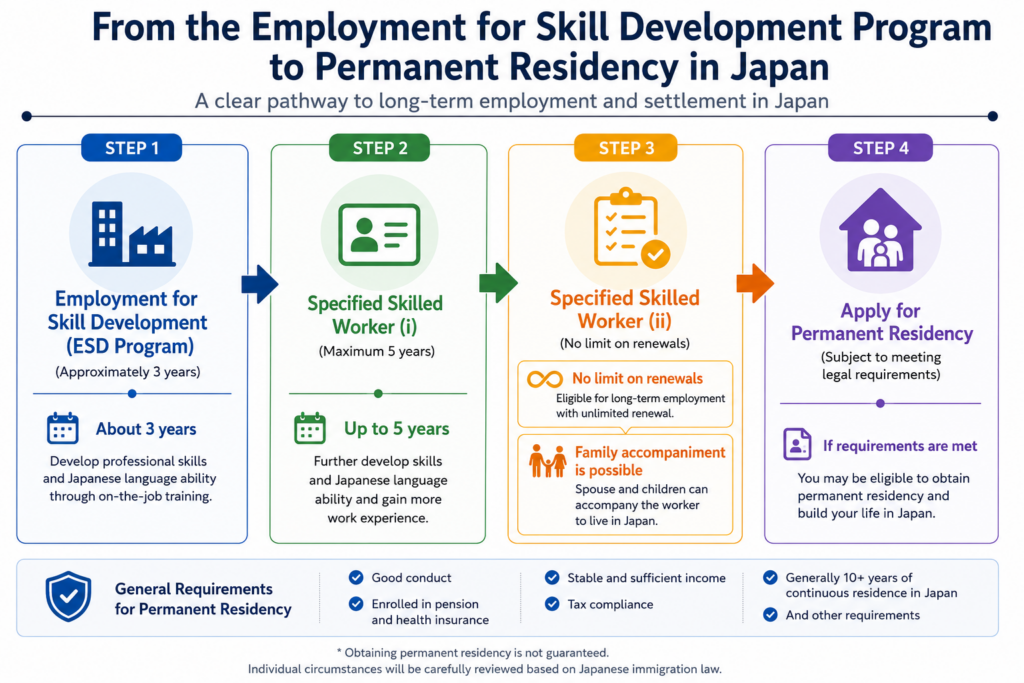
Although obtaining Specified Skilled Worker (ii) status does not automatically lead to permanent residency, it creates a realistic pathway toward long-term settlement in Japan.
Applicants must still satisfy the general requirements for Permanent Residency, including:
- Good conduct
- Stable income
- Tax compliance
- Pension and social insurance contributions
- Continuous residence in Japan
Developing Professional Skills and Japanese Language Ability
One of the most important features of the ESD Program is that workers are expected to develop both occupational skills and Japanese language ability while working in Japan.
Before beginning employment, applicants are generally required to demonstrate Japanese language proficiency at approximately A1 level (JLPT N5) or complete equivalent Japanese language training.
To transition from the ESD Program to Specified Skilled Worker (i) status, workers must pass:
- Grade 3 Trade Skill Test or the Specified Skilled Worker Evaluation Test
- Japanese language proficiency at approximately A2 level (JLPT N4)
To obtain Specified Skilled Worker (ii) status, workers must pass:
- Specified Skilled Worker (ii) Evaluation Test
- Japanese language proficiency at approximately B1 level (JLPT N3)
The program therefore functions as a structured career development system rather than simply a labour recruitment scheme.
The Employer’s Responsibilities
The success of the ESD Program depends not only on foreign workers but also on employers.
Companies must prepare an Employment for Skill Development Plan, outlining:
- Training objectives
- Job duties
- Skill development
- Japanese language education
- Career progression
Employers are expected to provide support by offering:
- Workplace training
- Japanese language education
- Assistance in preparing for skills examinations
- Support for Japanese language proficiency tests
This represents a significant change from the previous Technical Intern Training Program.
Greater Job Mobility
Under the former Technical Intern Training Program, changing employers was extremely difficult.
The ESD Program introduces greater labour mobility.
Workers who satisfy certain legal requirements will be permitted to transfer to another employer.
This reform aims to improve the protection of foreign workers while encouraging employers to provide better working conditions and career opportunities.
Recruitment Through Memoranda of Cooperation (MOC)
Japan also plans to strengthen the regulation of overseas recruitment.
In principle, foreign workers will be accepted only from countries that have signed a Memorandum of Cooperation (MOC) with Japan.
The purpose of this framework is to eliminate unethical recruitment agencies and prevent excessive recruitment fees charged to foreign workers before arriving in Japan.
Conclusion
The Employment for Skill Development Program represents a major turning point in Japan’s immigration policy.
Instead of treating foreign workers as temporary labour, Japan is beginning to establish a framework that develops skilled professionals capable of contributing to Japanese society over the long term.
The key features of the new program include:
- A clear pathway from the ESD Program to Specified Skilled Worker status
- Progressive development of occupational skills and Japanese language ability
- Greater protection of workers through improved job mobility
- Increased responsibilities for employers in supporting career development
- A realistic route toward long-term residence and, eventually, Permanent Residency
As Japan continues to face demographic challenges and labour shortages, the Employment for Skill Development Program is expected to become one of the country’s most significant immigration reforms.
Need Advice on Japan’s Immigration Procedures?
Our office provides professional immigration support in both English and Japanese, including:
- Employment for Skill Development (ESD)
- Engineer / Specialist in Humanities / International Services Visa
- Specified Skilled Worker Visa
- Highly Skilled Professional Visa
- Spouse Visa
- Permanent Residency
- Naturalization
Whether you are an employer planning to hire foreign workers or an individual seeking long-term residence in Japan, we would be pleased to assist you.
👉 Contact us here
📺 Watch the video on YouTube