


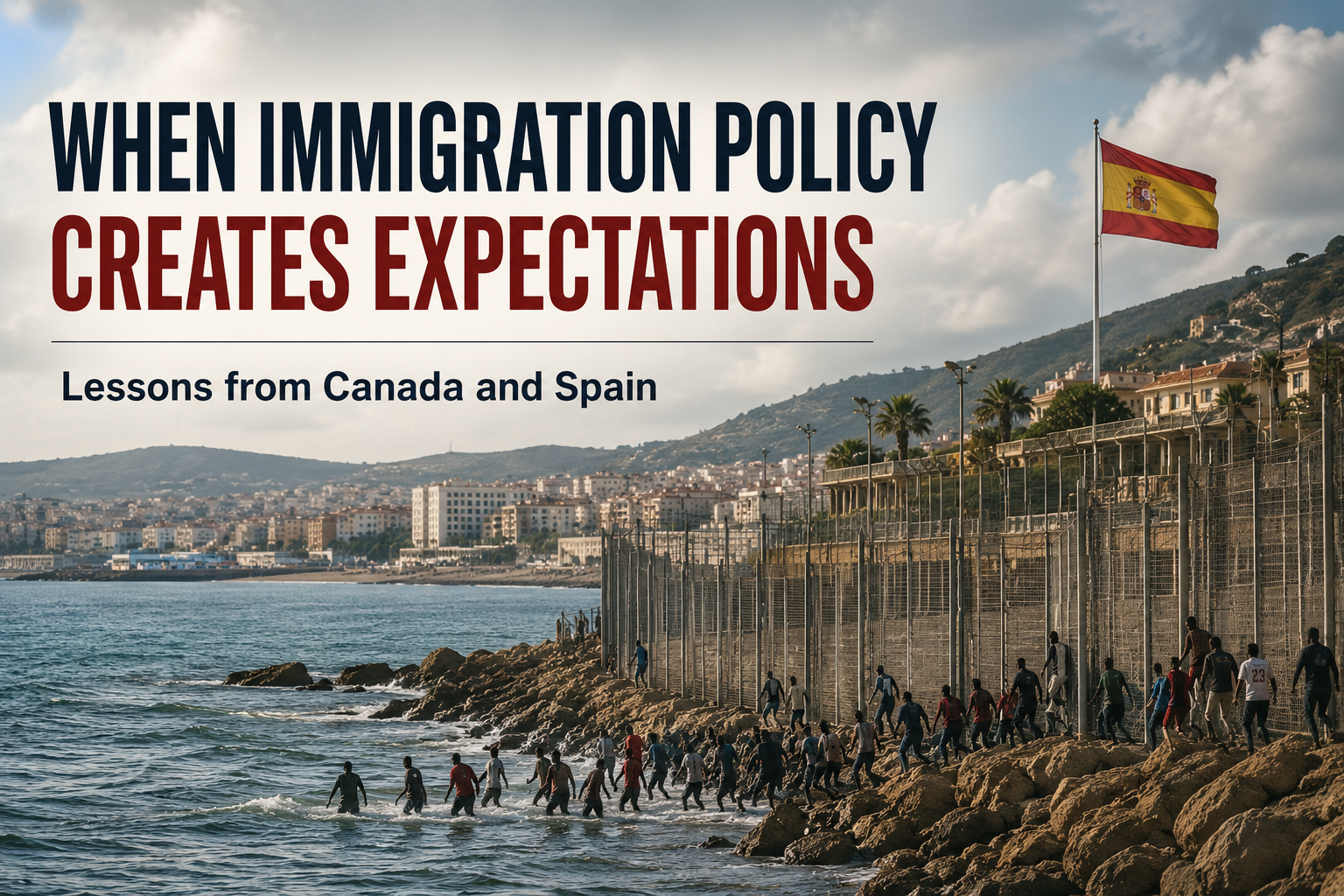
Immigration policy does not only determine who can enter or remain in a country today.
It can also influence what people believe may become possible tomorrow.
Recent events in Spain provide a striking example.
In 2026, Spain introduced an extraordinary regularization program for undocumented migrants and certain applicants for international protection already living in the country.
The government initially estimated that around 500,000 people could potentially benefit. By the time applications closed on June 30, however, it had received more than 1.17 million applications — more than twice the original estimate.
→ External link: Link “more than 1.17 million applications” to Spanish Government — Extraordinary Regularisation Results. The official final figure was 1,174,978 applications.
Then, in late July, approximately 72,000 migrants crossed from Morocco into Ceuta, Spain’s enclave in North Africa. Most were subsequently returned to Morocco, but the event resulted in numerous deaths and triggered intense political debate across Europe.
It would be far too simplistic to say that Spain’s regularization program caused the Ceuta crisis.
Economic conditions, social media misinformation, smuggling networks and perceptions created by other legal developments all appear to have played a role.
But the events raise an important question:
Can exceptional immigration policies influence future migration behavior by changing expectations?
Canada Has Faced a Similar Question
Canada provides a very different, but instructive, example.
During the COVID-19 pandemic, travel restrictions made it difficult to bring permanent residents from overseas. The Canadian government therefore turned increasingly to temporary residents already inside the country. IRCC itself explained at the time that travel restrictions were one reason for focusing on skilled immigrants already in Canada.
On February 13, 2021, Canada invited 27,332 Canadian Experience Class candidates to apply for permanent residence in a single Express Entry draw. The CRS cut-off fell to just 75.
→ External link: Link “27,332 Canadian Experience Class candidates” to IRCC — Express Entry Draw, February 13, 2021.
A few months later, the government introduced the Temporary Resident to Permanent Resident Pathway, creating temporary pathways for up to 90,000 essential workers and international graduates already in Canada, in addition to uncapped streams for eligible French-speaking applicants.
→ External link: Link “Temporary Resident to Permanent Resident Pathway” to IRCC — TR to PR Pathway announcement.
These were extraordinary measures for extraordinary circumstances.
But immigration policy does more than solve today’s problems.
It also sends signals.
For some prospective migrants, Canada’s pandemic-era policies may have reinforced a simple idea:
“If I can get into Canada first, another pathway to permanent residence may eventually become available.”
That was never a government promise.
But whether the perception was accurate is almost beside the point.
Migration decisions are based not only on today’s immigration rules, but also on expectations about what governments may do tomorrow.
If you are interested in the broader differences between the two immigration systems, see our Japan vs. Canada Immigration Systems: Practical Insights.
Exceptions Can Create Expectations
Spain and Canada are obviously very different cases.
Spain’s regularization primarily concerned people living in the country without regular immigration status or seeking international protection. Canada’s pandemic programs largely involved temporary residents legally living, studying or working in Canada.
But both illustrate the same policy challenge.
A government may introduce an exceptional immigration measure because of a pandemic, labour shortage or humanitarian situation.
The policy may be temporary.
The expectations it creates may not be.
International students, temporary workers and prospective migrants watch what governments do. They make major financial and personal decisions based partly on what they believe may happen in the future.
That does not mean governments should stop introducing exceptional programs.
Immigration systems need flexibility.
But they also need predictability.
Governments should consider not only whether a policy solves today’s problem, but also what message it may unintentionally send about tomorrow.
Perhaps that is one of the hardest challenges in immigration policy:
Every exception solves one problem today — but it may also shape expectations about the rules of tomorrow.
This article reflects the author’s analysis of immigration policy developments and is intended for general informational purposes.