


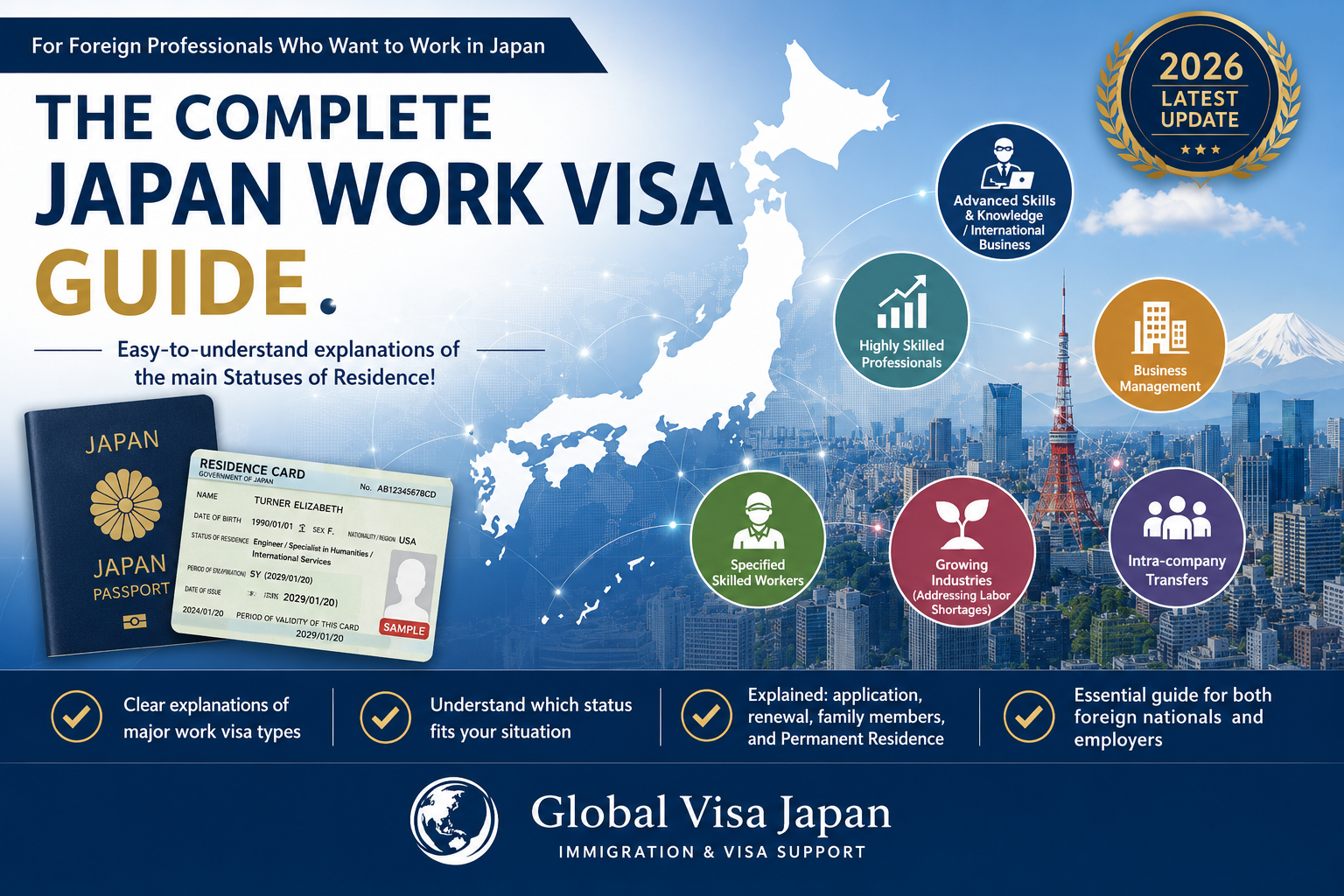
Watch the complete guide in just 6 minutes.
This video provides a practical introduction to Japan’s work visa system before you explore the detailed guide below.
Prefer reading? Continue below for the complete written guide with additional explanations and links.
Everything Foreign Professionals, Skilled Workers, Entrepreneurs and Employers Need to Know
Last Updated: July 2026
Working in Japan can be an exciting opportunity, whether you are an engineer, business professional, entrepreneur, skilled worker, teacher, or executive transferring from overseas. However, Japan’s immigration system is often misunderstood because the term “work visa” is commonly used to describe several different legal statuses.
Unlike many countries, Japan does not issue a single work permit that allows foreign nationals to perform any type of employment. Instead, every foreign worker must qualify for a specific Status of Residence, and each category permits only certain types of activities.
Choosing the correct Status of Residence is one of the most important steps in the immigration process. Applying under the wrong category can result in delays, requests for additional documents, or even refusal.
This guide provides a practical overview of Japan’s principal work-related Statuses of Residence in 2026. It explains who each category is designed for, the basic eligibility requirements, and the situations in which each status is commonly used.
If you need detailed guidance for a particular category—such as the Business Manager Visa, Engineer / Specialist in Humanities / International Services, or Specified Skilled Worker—you will also find links to our dedicated guides covering those topics in depth.
Why Japan Needs Foreign Workers
Japan is experiencing one of the world’s fastest demographic changes.
A declining birth rate, an aging population, and a shrinking workforce have created labour shortages across a wide range of industries. Manufacturing, construction, hospitality, healthcare, information technology, agriculture, logistics, and many service industries increasingly rely on foreign workers to sustain economic activity.
As a result, Japan has gradually expanded its immigration framework to accommodate different types of foreign workers. Today, opportunities exist not only for highly skilled professionals but also for entrepreneurs, researchers, skilled tradespeople, international business specialists, and workers in designated labour-shortage industries.
At the same time, Japan’s immigration system remains highly structured. Every foreign national must satisfy the legal requirements of a specific Status of Residence, and each category has different eligibility criteria, permitted activities, and renewal conditions.
Understanding these differences before accepting a job offer or planning a business in Japan can save considerable time and help avoid costly mistakes.
Understanding Japan’s Immigration System
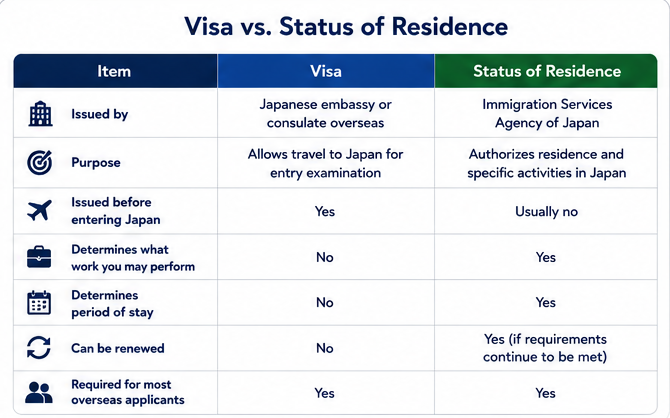
One of the most common misunderstandings is the difference between a visa and a Status of Residence.
Although people often use the expression “Japanese work visa,” the two terms have different legal meanings.
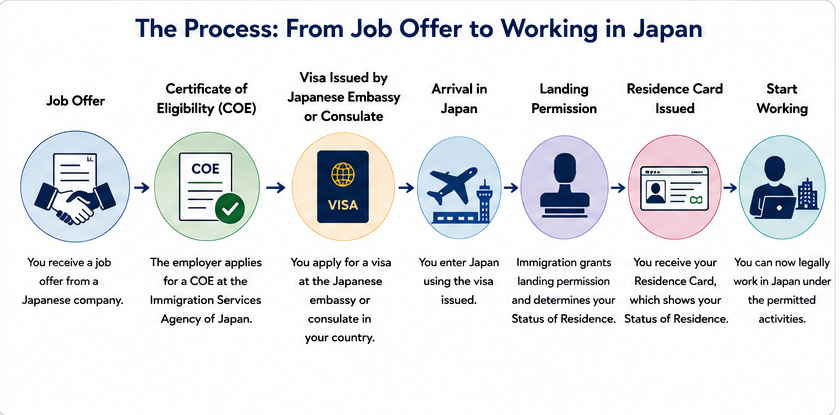
A visa is issued by a Japanese embassy or consulate outside Japan. It allows the holder to travel to Japan and request permission to enter the country.
A Status of Residence, on the other hand, is granted by the Immigration Services Agency and determines the activities a foreign national is legally permitted to perform while living in Japan.
Your Status of Residence governs:
- Whether you may work in Japan
- What type of work you may perform
- How long you may remain in Japan
- Whether family members may accompany you
- Whether your stay may be renewed
- Whether your residence may eventually lead to Permanent Residence
For most applicants, the key question is therefore not:
“Can I obtain a Japanese work visa?”
Instead, it is:
“Which Status of Residence best matches the work I will actually perform in Japan?”
That single decision determines the legal basis of your stay in Japan.
How to Choose the Right Japanese Work Visa
Japan currently has more than twenty different Statuses of Residence that permit employment.
Most foreign professionals, however, fall into a relatively small number of work-related categories.
The appropriate category depends on factors such as:
- The type of work you will perform
- Your educational background
- Your professional experience
- Whether you will work as an employee or manage your own business
- Whether you are transferring within the same corporate group
- Whether your occupation belongs to a designated labour-shortage industry
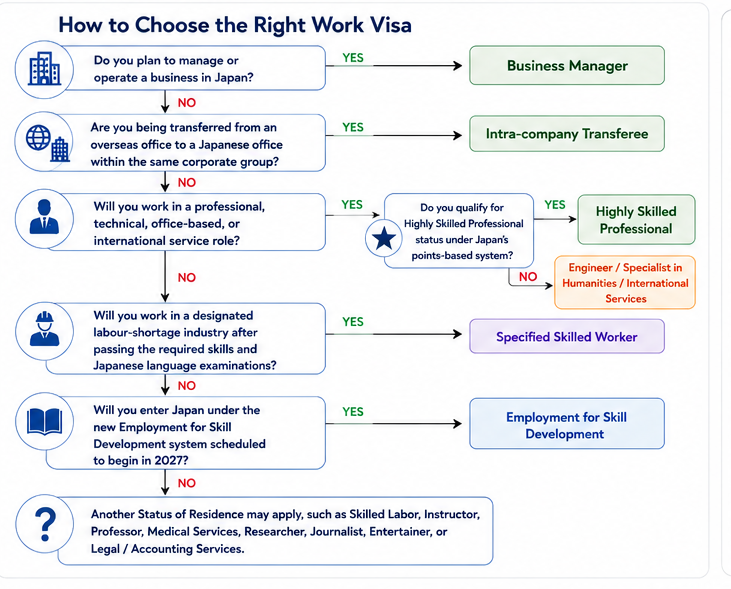
The following decision tree provides a practical starting point for identifying the Status of Residence that is most likely to apply to your situation.
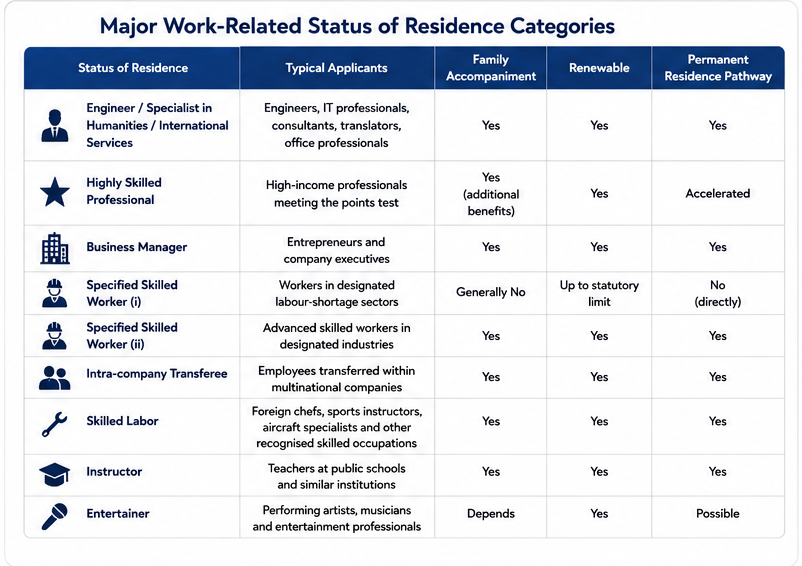
Major Japanese Work Visa Categories
The following table summarises the principal work-related Statuses of Residence covered in this guide.
Need Assistance with a Japanese Work Visa?
At Global Visa Japan, we assist foreign nationals and employers with a wide range of Japanese immigration procedures, including:
- Work Visa Applications
- Status of Residence Changes
- Extensions of Period of Stay
- Permanent Residence Applications
- Spouse Visa Applications
- Business Manager Visa Applications
- Certificate of Eligibility (COE) Applications
Whether you are planning to work in Japan, start a business, or hire foreign talent, our experienced immigration professionals are here to help.
Contact Global Visa Japan today for professional immigration assistance tailored to your situation.
Related Guides
- Complete Guide to the Engineer / Specialist in Humanities / International Services
- Complete Guide to the Business Manager Visa
- Complete Guide to the Highly Skilled Professional Visa
- Complete Guide to the Specified Skilled Worker (SSW) Visa
- Complete Guide to Permanent Residence in Japan
Official Resources
For the latest immigration rules and application procedures, please refer to the following official websites: