


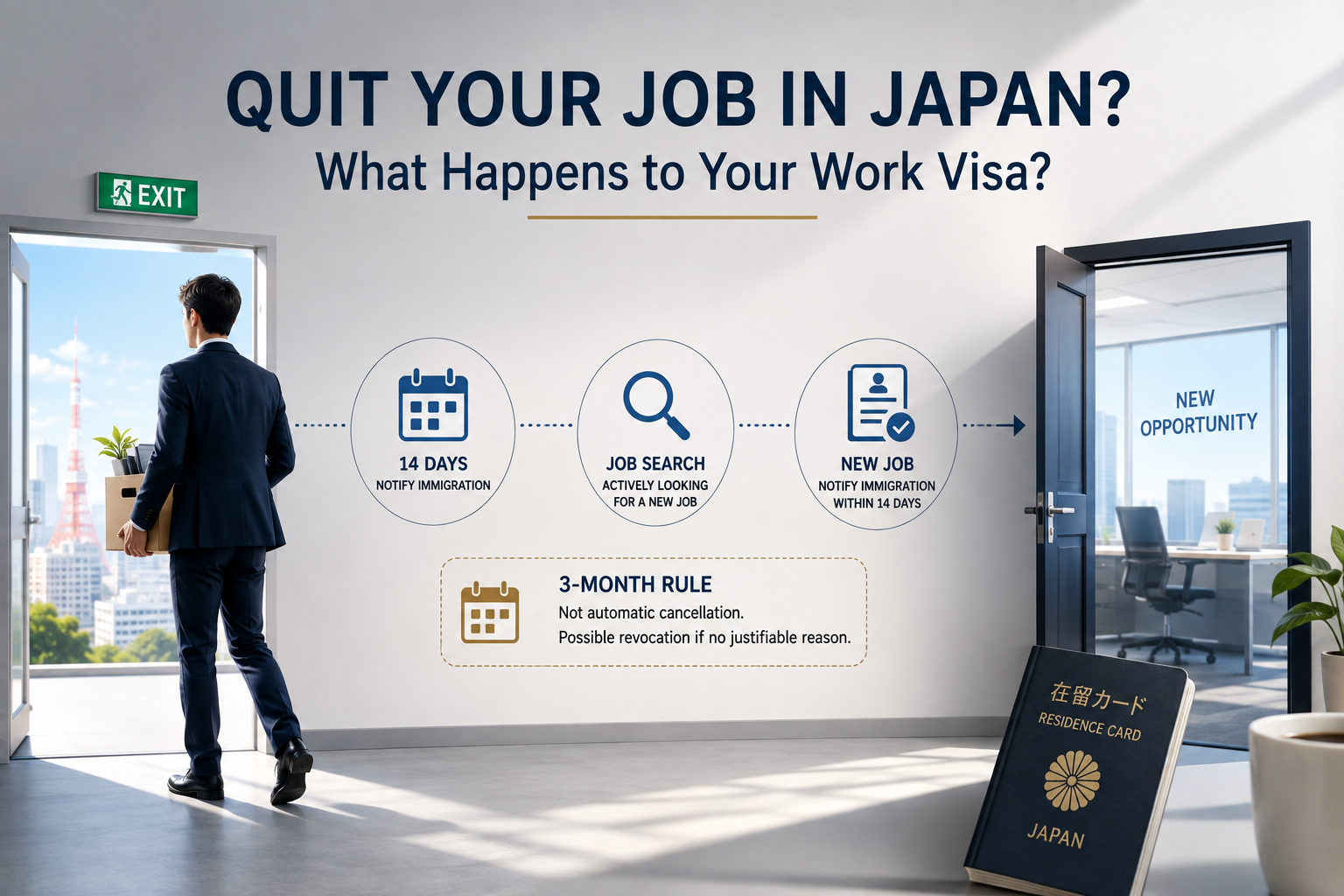
If you are working in Japan under a work-related status of residence, one question can become very important when you leave your job:
What happens to my visa if I quit my job?
You may also have heard that you must find another job within three months or your visa will automatically be cancelled.
There is a lot of information online about this issue, and two different rules — 14 days and three months — are sometimes confused.
The short answer is:
Quitting your job does not automatically cancel your status of residence.
However, leaving your employer does trigger a notification requirement, and remaining in Japan for an extended period without engaging in the activities permitted under your status of residence can raise a separate issue concerning revocation of status.
In this article, we explain what generally happens after leaving a job, using the Engineer/Specialist in Humanities/International Services status as the main example.
1. Does My Work Visa Become Invalid If I Quit My Job in Japan?
No.
Leaving your employer and losing your status of residence are not the same thing.
For example, if you hold Engineer/Specialist in Humanities/International Services status and resign from your company, your status does not automatically become invalid on your last day of employment.
However, this does not mean that you can simply ignore your immigration situation until the expiration date printed on your residence card.
Two separate rules become particularly important:
1. The 14-day notification requirement
and
2. The so-called “3-month rule” relating to revocation of status
Understanding the difference between these two rules is essential.
2. Do I Have to Notify Immigration After Quitting My Job?
Yes.
Engineer/Specialist in Humanities/International Services is one of the statuses subject to the notification requirement concerning an affiliated or contracting organization.
When you leave your employer and your employment contract ends, you are generally required to notify the Immigration Services Agency of Japan.
The notification must be submitted within 14 days from the date the relevant event occurs.
The Immigration Services Agency specifically states that events such as leaving a company and joining a new company must be reported within 14 days.
In simple terms:
Leave your job → Notify Immigration within 14 days
The notification can be made online, by mail, or at a Regional Immigration Services Bureau. Supporting documents such as an employment contract are generally not required for the notification itself.
For details, see the Immigration Services Agency’s official guidance on Notification Concerning Affiliated Organizations / Contracting Organizations.
3. What If I Miss the 14-Day Notification Deadline?
This is another common concern.
If more than 14 days have already passed, that does not mean that you should simply forget about the notification.
The Immigration Services Agency instructs foreign nationals who discover that they failed to make the required notification to submit it promptly.
It also warns that failure to notify, or submitting a false notification, may be subject to penalties and may negatively affect future immigration applications.
Therefore, if you have missed the deadline, it is generally better to address the omission rather than leave it unresolved.
4. What Is the 3-Month Rule for a Work Visa in Japan?
This is probably the most misunderstood part of the process.
You may have heard something like:
“If you don’t find another job within three months, your work visa will automatically be cancelled.”
That is not an accurate description of the rule.
Article 22-4 of the Immigration Control and Refugee Recognition Act provides for revocation of a foreign national’s status of residence in certain circumstances.
For certain statuses of residence, including Engineer/Specialist in Humanities/International Services, not engaging in the activities corresponding to the person’s status of residence for three months or more can constitute grounds for revocation.
However, there is an important qualification:
This does not apply where there is a justifiable reason for not engaging in those activities.
So the three-month period should not be understood as a second expiration date for your residence card.
In other words:
Three months unemployed ≠ automatic cancellation of your status of residence.
Rather, the three-month period relates to the legal framework under which Immigration may consider revocation of status.
The Immigration Services Agency provides further information about this system on its official Revocation of Status of Residence page.
5. Can I Stay in Japan While Looking for a New Job?
This requires more careful consideration.
The fact that three months have passed does not automatically mean that you must leave Japan. At the same time, having time remaining on your residence card does not necessarily mean that you can remain indefinitely without engaging in the activities associated with your status.
The individual circumstances matter.
Relevant factors may include:
- why you are no longer engaged in your authorized activity;
- whether you genuinely intend to resume appropriate employment;
- what job-search activities you have undertaken; and
- how long you have been without qualifying employment.
For this reason, if you are actively looking for another job after leaving your employer, it is sensible to keep records of your job search, such as applications, interviews and communications with prospective employers.
Whether a particular situation constitutes a “justifiable reason” ultimately depends on the individual circumstances. Simply saying that you are looking for work should therefore not be treated as a guarantee that revocation could never become an issue.
6. Do I Need a New Work Visa When I Change Jobs in Japan?
Not necessarily.
The Immigration Services Agency states that where the activities at the new employer fall within the activities permitted under the foreign national’s existing status of residence, the person may continue to reside in Japan under that status.
For example, suppose you hold Engineer/Specialist in Humanities/International Services status and move from Company A to Company B.
If your new position at Company B also qualifies under Engineer/Specialist in Humanities/International Services, changing employers does not, by itself, necessarily require an application for Change of Status of Residence.
But there is an important question:
Does your new job actually fall within the scope of your current status of residence?
This cannot always be determined simply from the company name or your job title. Your actual duties and other relevant circumstances need to be considered.
Related reading:
Engineer/Specialist in Humanities/International Services: Basic Requirements
How Immigration Examines Engineer/Specialist in Humanities/International Services Applications
7. Do I Have to Notify Immigration After Finding a New Job?
Generally, yes.
Joining a new contracting organization is another event that may trigger the notification requirement.
A typical sequence therefore looks like this:
Leave Company A
↓
Notify Immigration within 14 days
↓
Look for a new job
↓
Join Company B
↓
Notify Immigration within 14 days
One useful detail in the Immigration Services Agency’s Q&A is that you cannot file the notification in advance simply because you know you will be changing jobs next month.
The notification should be made after the relevant event has actually occurred.
8. What If My New Job Is Different From My Previous Job?
This can be an important issue, particularly for someone changing occupations or industries.
One option is to apply for a Certificate of Authorized Employment (Shuro Shikaku Shomeisho / 就労資格証明書).
The certificate confirms, upon application, the types of income-generating activities that the foreign national is authorized to perform based on their existing immigration status.
It can therefore be useful in certain cases where there is uncertainty about whether a new position falls within the scope of the person’s current status of residence.
Even where no immediate change of status is required, the compatibility of the new job with your existing status can also become important at your next application for Extension of Period of Stay.
9. 14 Days vs. 3 Months: What’s the Difference?
The easiest way to remember the rules is:
14 days = notification requirement
3 months = potential revocation issue
They are not the same rule.
Leaving your job does not automatically cancel your status of residence.
Likewise, reaching three months without qualifying employment does not mean that your status automatically disappears on that day.
However, neither should be ignored.
After leaving a job, you should make the required notification, consider how your period without qualifying employment affects your immigration situation, and make sure that your next job actually falls within the activities permitted by your current status of residence.
Final Thoughts
Losing or leaving a job can be stressful, particularly when your ability to live in Japan is connected to your employment.
But two opposite assumptions can cause unnecessary problems:
“I quit my job, so my visa is immediately gone.”
and
“My residence card is valid for another two years, so I don’t need to do anything.”
Neither is a good way to approach the situation.
The better approach is to understand what must be reported, what the three-month rule actually means, and whether your next employment is compatible with your current status of residence.
If you have left your job, have been unemployed for an extended period, or are considering a new position that is substantially different from your previous work, obtaining professional advice before your next immigration application may help identify potential issues early.
Sources
This is the Immigration Services Agency guidance we used for the 14-day notification requirement, including resignation and joining a new company. The official Q&A expressly states that these notifications should be made within 14 days of the event.
Immigration Services Agency of Japan – Immigration and Residence Examination Q&A
Immigration Services Agency of Japan – Revocation of Status of Residence